AI agents are accessing your data. Who’s watching?
Stop S3 exfiltration before it becomes a breach.
An S3 breach can look like a legitimate role making a normal API call — until it’s too late. Entroptics Shield learns the rhythm of your data to catch the “low-and-slow” exfiltration rules miss.
Exfiltration, lateral movement, velocity, identity anomalies, and more — with FileDNA object context
<5m
Event to alert
CloudTrail-native streaming — not batch processing hours later
<1m
NHI anomaly detection
AI agents, Lambda functions, and service accounts baselined and monitored independently
4
Baseline layers
Per-prefix, per-role, per-identity type, per-file — each one narrows what counts as normal
Enterprise-grade encryption
Audit-ready logging
Per-tenant data isolation
Inside the product
Detection to resolution in one platform.
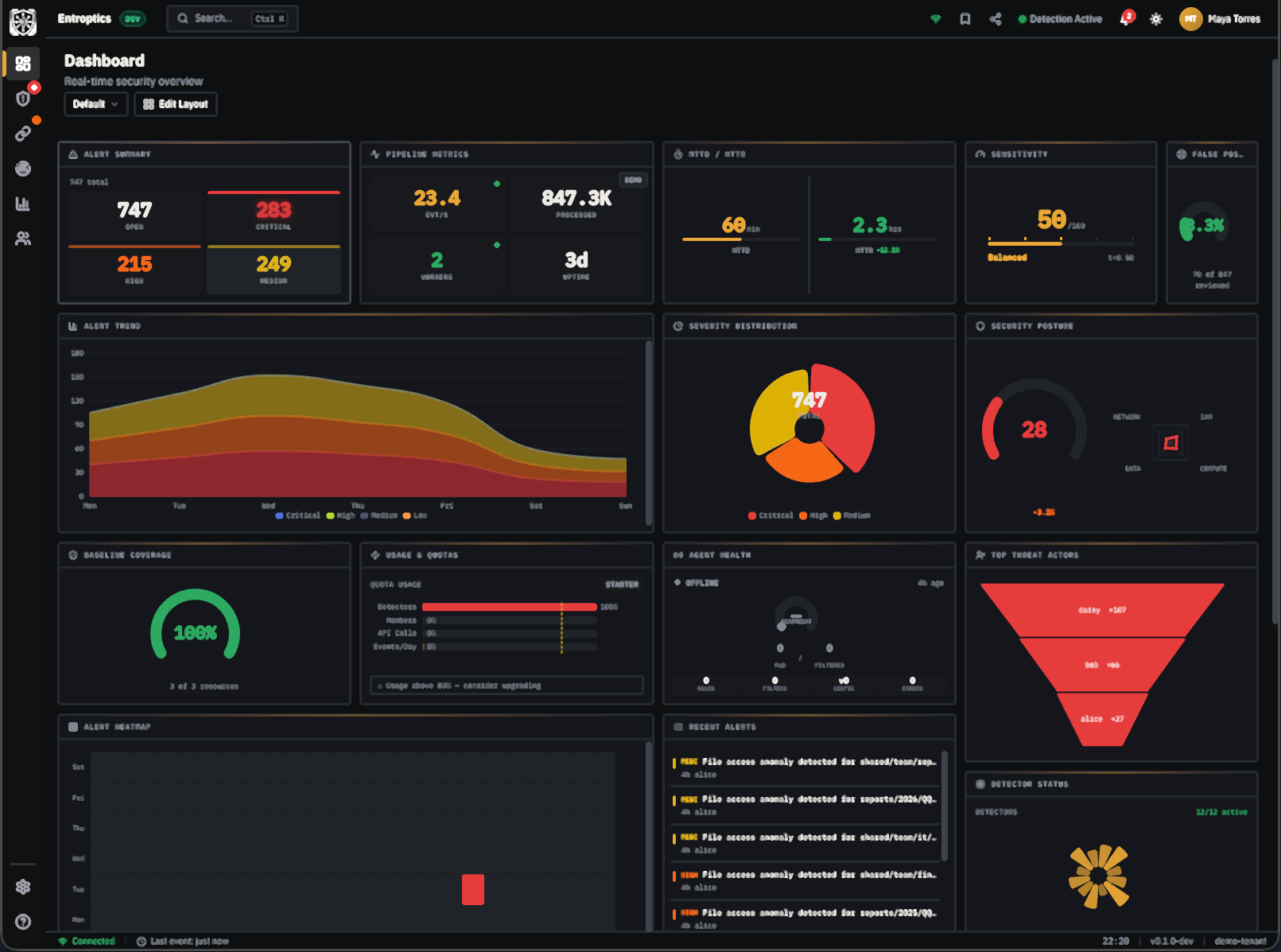
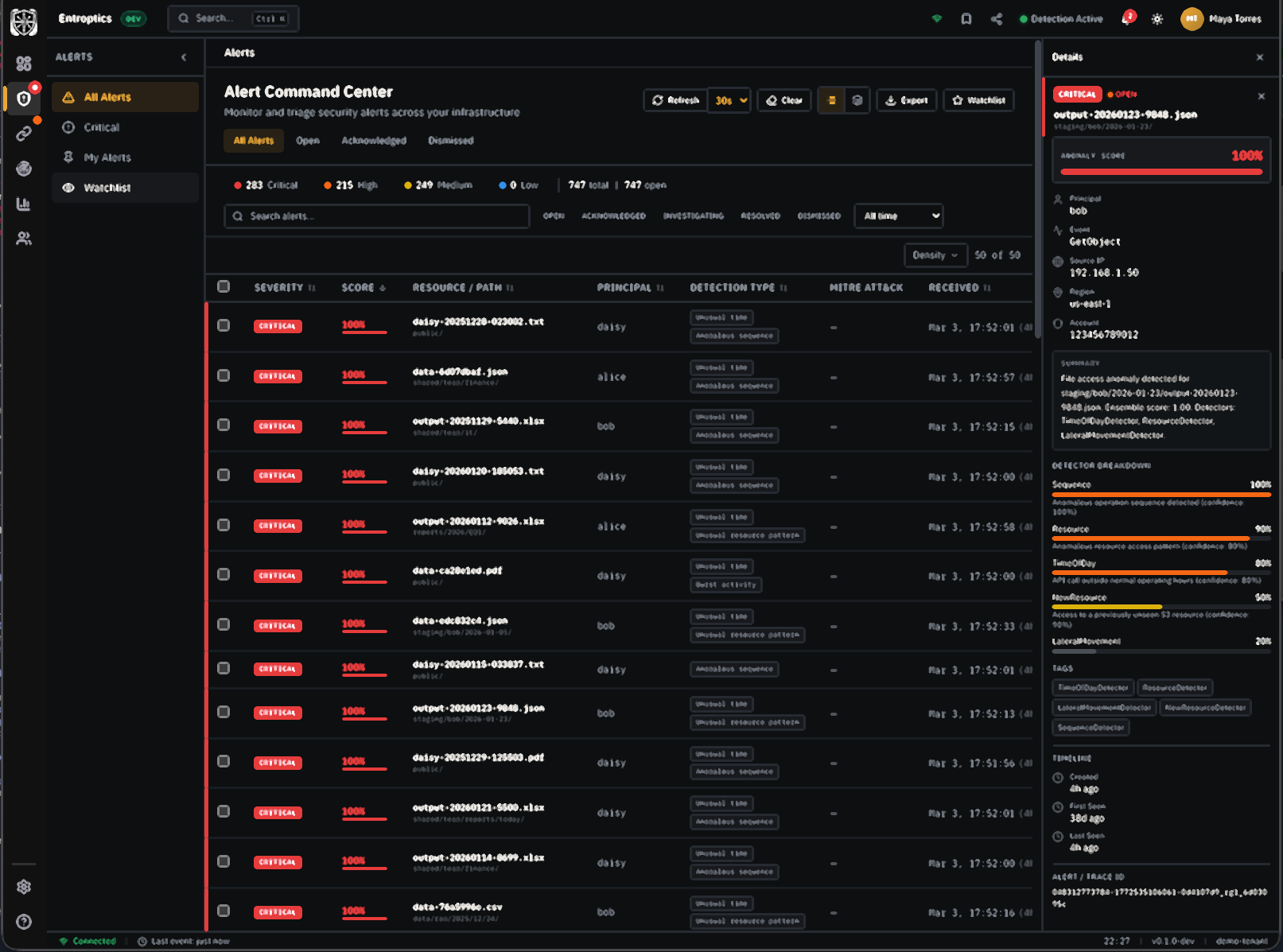
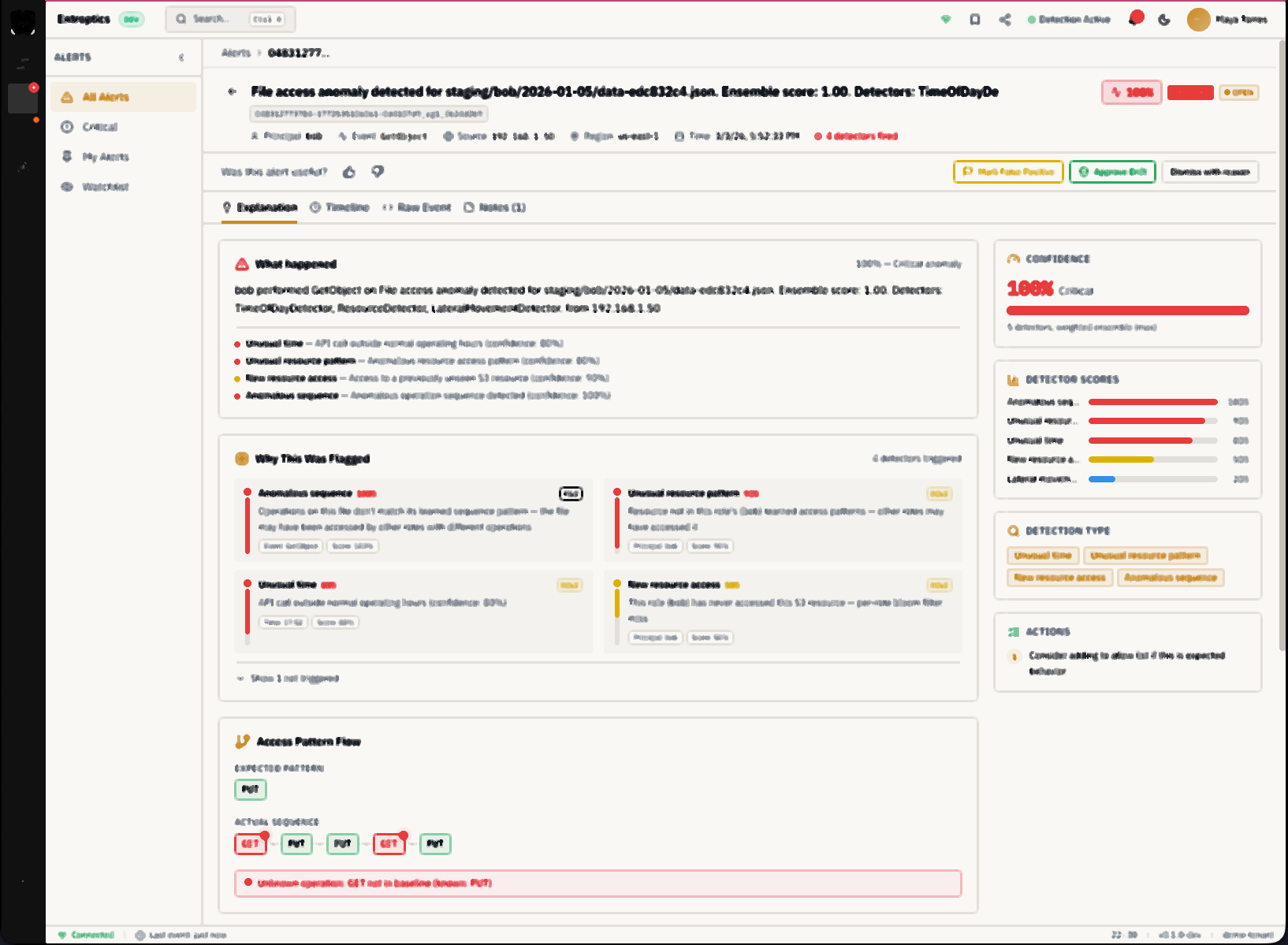
See how Entroptics Shield detects a behavioral anomaly, surfaces root cause analysis, and routes an alert to your team. Explore the dashboard, alert triage, and investigation workspace below.
Security overview
See where your attention is needed.
Bring alert trends, severity, baseline coverage, and actor risk into a single operational view.
Connect your CloudTrail, wait for baselines to build, start seeing anomalies. Most teams have their first insight within hours.
01
Connect your CloudTrail
One integration. No agents to install, no code changes. Entroptics Shield reads your S3 activity stream and starts learning immediately.
02
Baselines build themselves
Within hours, every prefix, role, and file has a behavioral model. Your environment defines what's normal — not a generic ruleset.
03
Anomalies surface in minutes
14 detectors score every S3 event against its baseline. Velocity spikes, new actors, lateral movement, exfiltration patterns — scored and ranked by severity.
04
Investigate and close
Every alert comes with a timeline, root cause trace, and detector breakdown. Escalate to a full incident when needed — SLA tracking, evidence collection, post-mortem.
From CloudTrail activity to investigation Illustrative event stream
Connecteds3://acme-prod
BaselineAccess patterns indexed
MonitorStreaming events
EventGetObject
Spike340 GetObject calls / 12s
Anomalyactor::tmp-analytics
AlertSlack #security-alerts
IncidentENT-0091 opened
Features
What’s under the hood.And why it matters.
Detection is the hard part — we built 14 parallel detectors to get it right. Everything else your team needs to investigate, respond, and report is here too.
Core innovations
Zero-Config Normalcy
Your environment defines the rules. We learn the "rhythm" of your data down to the file level so you never have to write a regex again.
"Anomaly" to "Malicious Intent"
Most tools flag everything "unusual" (Noise). We use Noisy-OR Signal Fusion across 14 detectors to distinguish between a busy developer and a credential theft in progress.
FileDNA Fingerprinting
Every S3 object builds its own access fingerprint. First-time access to a file triggers instantly — not buried in prefix-level averages where low-and-slow exfiltration hides.
NHI-Native Intelligence
We don't treat a Lambda function like a human. Entroptics Shield understands the unique physics of Non-Human Identities (NHIs), reducing false positives by 90% in dynamic CI/CD environments.
Complete security operations platform
Autonomous Triage, Verified Response.
Every alert links to a timeline, sequence flow, and automated root cause trace. See the full chain of events — who accessed what, when, and what changed.
Incident Lifecycle
Detection through post-mortem in one place. SLA tracking, response checklists, evidence collection. Push to Jira when you need to.
Built for the 2027 SOC
Your AI agents (Torq, Dropzone, Claude) use our MCP Server to do the 30 minutes of investigation work in 300 milliseconds. Agents build the investigation packet; you just pull the trigger
Reports & Compliance
Generate PDF reports on demand or on schedule. Pre-built templates for compliance reviews. CSV export for everything else.
Detection Tuning
Three global presets — Strict, Balanced, Relaxed — or dial each detector individually. Suppression rules and maintenance windows keep noise out of your queue.
OCSF · Security Hub · EventBridge
Alerts ship in OCSF Detection Finding format. Splunk, Cribl, Security Hub consume them natively. EventBridge routes them to automated remediation. Full REST API with M2M auth.
Why Entroptics Shield
Rules miss what behavior reveals.
Signature tools handle known threats. Shield looks for the behavioral anomalies that don’t match a signature. The two approaches provide complementary coverage.
Comparing behavioral detection with signature-only detection. Individual security products may combine both approaches.
Shield capabilities compared with signature-only detection across detection, intelligence, operations, workflow, and AI and non-human identities.
Capability
Entroptics Shield
Signature-only detection
Detection
Approach
Behavioral — learns what's normal, flags what isn't
Signature — matches known threat patterns
Novel threats
Flags access patterns never seen before
Limited to known attack signatures
False positive rate
Tuned to your environment's actual patterns
Generic thresholds across all accounts
Intelligence
Baseline granularity
Per prefix · per role · per file
Account-level or bucket-level
File intelligence
FileDNA fingerprint per object
No per-object behavioral context
Timing awareness
Velocity and timing encoded per event
Count-based thresholds
Operations
Investigation
Root cause, sequence diagrams, timeline
Alert with severity label
Incident management
Built-in lifecycle with post-mortem
Separate SOAR/ticketing tool needed
Compliance reporting
On-demand PDF reports
Manual data export and formatting
Workflow
Known signatures
Not signature-based — complementary
Strong threat intel coverage
Time to value
First insights within hours
Rules need authoring and tuning
Ongoing maintenance
Baselines adapt automatically
Rules need manual updates
AI & NHI
Identity classification
Separate baselines: human, service, Lambda, AI agent
No identity-type distinction
NHI detection
Deviation flagged in under a minute
No role-level behavioral baseline
Output format
OCSF · Security Hub · EventBridge · REST API
Depends on the tool and its integrations
Fits your security operations
Useful where your team already works.
Alerts ship in OCSF Detection Finding format (Event Class 2004), with MITRE ATT&CK mappings, detector-level evidence, and full actor/resource context. Security Hub, Splunk, Cribl, and Security Lake consume the findings. EventBridge routes them to automated remediation; the REST API includes M2M authentication.
AWS Security HubEventBridgeOCSFSplunkCriblSecurity LakeEmailSlackPagerDutyJiraWebhooksREST API · M2MMCPA2A
Shield analyzes who accessed what, when, and from where through CloudTrail. It does not read, store, or transmit your S3 object contents.
Control over consequential actions.
High-impact actions require human approval. All actions are audit-tracked and rate-limited. Tenant isolation is enforced — one tenant’s agent cannot see or act on another tenant’s data. Enterprise-grade encryption and audit-ready logging support your security operations.
Evidence for people and agents.
Enterprise plans include MCP and A2A integration. AI security tools such as Torq, Dropzone, and Claude can query detection data, investigate findings, and trigger response workflows using the same evidence your analysts see. Agents build the investigation packet; your team approves consequential actions.
Shield plans
Start free. Scale when ready.
Every plan includes all 14 detectors. Early access spots are limited. Save 10% with annual billing.
14 detectors run in parallel on S3 events. Each one builds a behavioral model at a different layer — prefix, role, identity type, and individual file. When access deviates from what’s been learned, detectors score the event and an ensemble method surfaces the anomaly.
How is this different from GuardDuty?
Shield focuses on the access patterns of your S3 roles, prefixes, and objects. GuardDuty provides broader AWS threat detection, including its own anomaly and threat-intelligence signals. The products can be used together for complementary context.
Is this just a detection engine?
No. Detection is the core, but you also get alert triage, investigation with root cause analysis, incident management with post-mortems, entity risk scoring, compliance reports, and integrations with Slack, PagerDuty, Jira, and webhooks.
Does Shield access my file contents?
No. Shield analyzes access metadata from CloudTrail — who accessed what, when, and from where. It does not read S3 object contents.
How long does setup take?
One CloudTrail integration. Baselines start building immediately and mature over 24–48 hours depending on your activity volume.
Can I integrate with my existing security stack?
Alerts output in OCSF format, so Security Hub, Splunk, and Cribl consume them natively. EventBridge support for automated remediation. Slack, PagerDuty, Jira, webhooks, and a REST API with M2M auth for everything else.
Do you support MCP and A2A?
Enterprise plans include MCP and A2A integration. Your AI security tools can query detection data, investigate findings, and trigger response workflows — using the same evidence your analysts see.
How do autonomous actions stay safe?
High-impact actions require human approval. All actions are audit-tracked and rate-limited. Tenant isolation is enforced — one tenant's agent cannot see or act on another tenant's data.
Does Shield monitor AI agents and Lambda functions?
Yes. Every IAM principal is classified by identity type — human, service account, Lambda, CI/CD, AI agent. Each type gets its own behavioral baseline. A compromised LLM pipeline or rogue Lambda is flagged within a minute of deviating from its learned pattern.
What output format do findings use?
OCSF Detection Finding format (Event Class 2004). Findings include MITRE ATT&CK mappings, detector-level evidence, and full actor/resource context. Consumable by Security Hub, Splunk, Cribl, and Security Lake without transformation.
How do I get access?
We're in early access — 10 new teams per week. Join the waitlist for Free, request early access for Team, or book a demo for Business and Enterprise. We respond within 1 business day.
What does the name mean?
Entropy + Optics. We measure the disorder in your access patterns and give you the lens to see what matters. When entropy spikes, something unusual is happening.